Shen
Laboratory
 Epigenomic Analysis in Human Disease
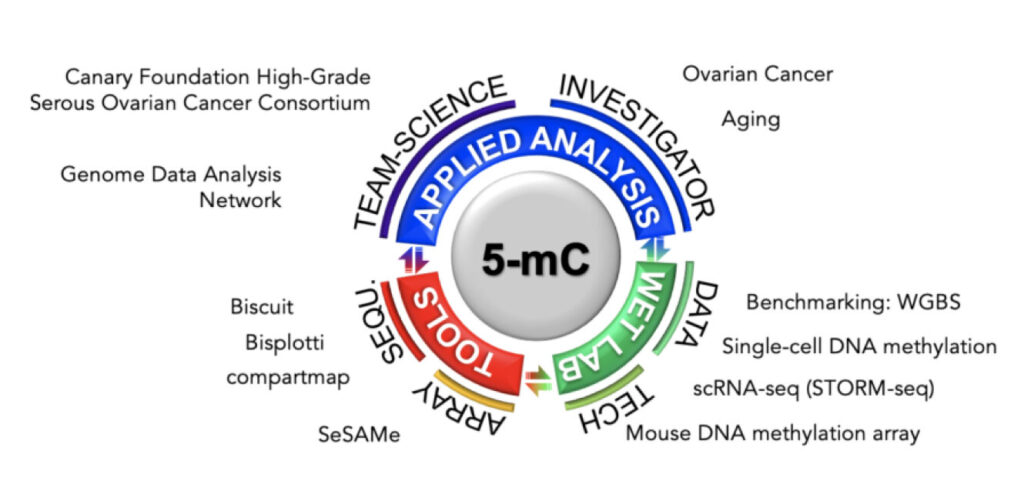
The Shen Laboratory focuses on the epigenome and its interaction with the genome in various diseases, with a specific emphasis on female cancers and cross-cancer comparisons. The Shen team uses bioinformatics as a tool to understand the etiology, cell of origin, and epigenetic mechanisms of various diseases and to devise better approaches for cancer prevention, detection, therapy, and monitoring. Team members have extensive experience with genome-scale DNA methylation profiles in primary human samples and have made major contributions to epigenetic analysis within The Cancer Genome Atlas (TCGA).
DNA methylation is ideally suited to deconstruct heterogeneity among cell types within a tissue sample. In cancer research, this approach can be used for both cancer cell clonal evolution studies or for quantifying normal cell infiltration and stromal composition. The latter can provide insights into the tumor microenvironment. For non-cancer studies, this method is a useful tool to accurately estimate different cell populations and provide insights into lineage structures and population shifts in disease. The Shen lab also is interested in translational applications of epigenomic technology. To this end, the lab translates markers that emerge from bioinformatics analysis into clinical assay development, marker panel assembly, and optimization, with the ultimate goal of clinical testing and validation.
Featured News & Featured Publications
Learn More
Compendium of patient-derived models offers new opportunities for cancer research, precision oncology

New ‘atlas’ may aid search for markers of early-stage ovarian cancer

Van Andel Institute scientists develop technique for high-resolution single cell epigenetic analysis
Dror E… Shen H, Pospisilik JA. 2023. Epigenetic dosage identifies two major and functionally distinct β cell subtypes. Cell Metab.
Brown JR … Shen H … Buckanovich RJ. Phase II clinical trial of metformin as a cancer stem cell–targeting agent in ovarian cancer. JCI Insight.
Carrot-Zhang J .. Shen H … Ziv E. Comprehensive analysis of genetic ancestry and its molecular correlates in cancer. Can Cell.
Gao GF … Shen H … Noble MS. Before and after: Comparison of legacy and harmonized TCGA Genomic Data Commons’ data. Cell Sys.
Wilson MR … Shen H … Chandler RL. ARID1A and PI3-kinase pathway mutations in the endometrium drive epithelial transdifferentiation and collective invasion. Nat Commun.
Our Impact
We’re raising thousands to save millions.
We’re turning hope into action for the millions of people around the world affected by diseases like cancer and Parkinson’s. Find out how you can help us make a difference.
- 141 peer-reviewed papers published in 2025, 74 of which were in high-impact journals
- 15 VAI-SU2C Epigenetics Dream Team clinical trials launched to date
- 10 clinical trials and related projects supported by VAI through the International Linked Clinical Trials Program

Hui Shen, Ph.D.
Professor, Department of Epigenetics
Areas of Expertise
Epigenomics, DNA methylation, bioinformatics, ovarian cancer, pan-cancer comparison, genome-epigenome interaction
Biography
An expert in bioinformatics and computational biology, Dr. Hui Shen develops and applies cutting-edge genomics technologies and bioinformatic tools to investigate the regulatory mechanisms of gene transcription and cell differentiation — collectively known as epigenetics. Her multi-faceted research has led to improved understanding of molecular and cellular mechanisms driving various cancer types, particularly ovarian cancer.
Dr. Shen earned her B.Sc. in biology from Nanjing University and her Ph.D. in genetic, molecular and cellular biology from the University of Southern California (USC), where she was supported by a Provost Ph.D. Fellowship. She was part of The Cancer Genome Atlas (TCGA) team, a landmark multi-institutional effort to map the molecular basis of cancer. Dr. Shen joined Van Andel Institute in 2014 as an assistant professor, rising to associate professor in 2018 and full professor in 2023.
She is an F1000 Faculty Member in Cancer Epigenetics and has received numerous honors, including the Liz Tilberis Award from the Ovarian Cancer Research Alliance, an NIH/NCI ESI MERIT Award, and an AACR Team Science Award. In 2025, she was elected to the College of Fellows of the American Institute for Medical and Biological Engineering (AIMBE) in recognition of her contributions to computational cancer epigenetics.
Selected Publications
For a full list of Dr. Shen’s publications, please visit Google Scholar.
DNA Methylation Analysis Tools
BISCUIT
The BISulfite-seq CUI Toolkit (BISCUIT) is a tool for analyzing sodium bisulfite conversion-based DNA methylation/modification data. It was written to align, perform DNA methylation extraction and call single nucleotide mutations from cytosine-converted sequencing data.
Access BISCUIT ➔
Related Publication
Zhou W, Johnson BK, Morrison J, Beddows I, Eapen J, Katsman E, Semwal A, Habib W, Heo L, Laird PW, Berman B, Triche Jr TJ, Shen H. 2024. BISCUIT: an efficient, standards-compliant tool suite for simultaneous genetic and epigenetic inference in bulk and single-cell studies. Nuc Acids Res 52(6):e32.
BISCUIT Snakemake Workflow
The BISCUIT Snakemake Workflow is a Snakemake-based pipeline to run BISCUIT alignment and DNA methylation extraction across all samples in an experiment. It also provides many optional steps including a variety of quality control steps.
Access BISCUIT Snakemake Workflow ➔
Dupsifter
Dupsifter is a command line tool for marking PCR duplicates in both WGBS and WGS datasets.
Access Dupsifter ➔
Related Publication
Morrison J, Zhou W, Johnson BK, Shen H. 2023. Dupsifter: A lightweight duplicate marking tool for whole genome bisulfite sequencing. Bioinformatics 39(12):btad729.
SeSAMe
SeSAMe is an R/Bioconductor package for processing Illumina Infinium DNA methylation array data.
Access SeSAMe on GitHub ➔
Access SeSAMe on Bioconductor ➔
Related Publication
Zhou W, Triche Jr. TJ, Laird PW, Shen H. 2018. SeSAMe: reducing artifactual detection of DNA methylation by Infinium BeadChips in genomic deletions. Nuc Acids Res 46(20):e123-e123.
RNA-Sequencing Tools
STORMqc
STORMqc is a Snakemake-based pipeline for quality control of STORM-seq data such as finding reads mapped to undesirable locations, basic read quality metrics and number of reads.
Access STORMqc ➔
Tranquillyzer
Tranquillyzer (TRANscript QUantification In Long reads-anaLYZER) is a flexible, architecture-aware deep learning framework for processing long-read single-cell RNA-seq data.
Access Tranquillyzer ➔
Tranquillyzer-nf
Tranquillyzer-nf is a Nextflow-based pipeline for reproducible processing of long-read single-cell RNA-seq experiments with Tranquillyzer.
Access Tranquillyzer-nf ➔
General Tools
iscream
iscream is an R/C++ package for efficiently reading BED files into formats usable within the R/Bioconductor framework. It is optimized to query genomic regions, summarize the queried data and make matrices.
Access iscream on GitHub ➔
Access iscream on Bioconductor ➔
Synthbar
Synthbar adds synthetic sequences such as cell barcodes or unique molecular indexes to reads to make them conform to an expected format for downstream analysis.
Access Synthbar ➔
Related Publication
Morrison J, Johnson BK, Shen H. 2025. Synthbar: A lightweight tool for adding synthetic barcodes to sequencing reads. BioRxiv.
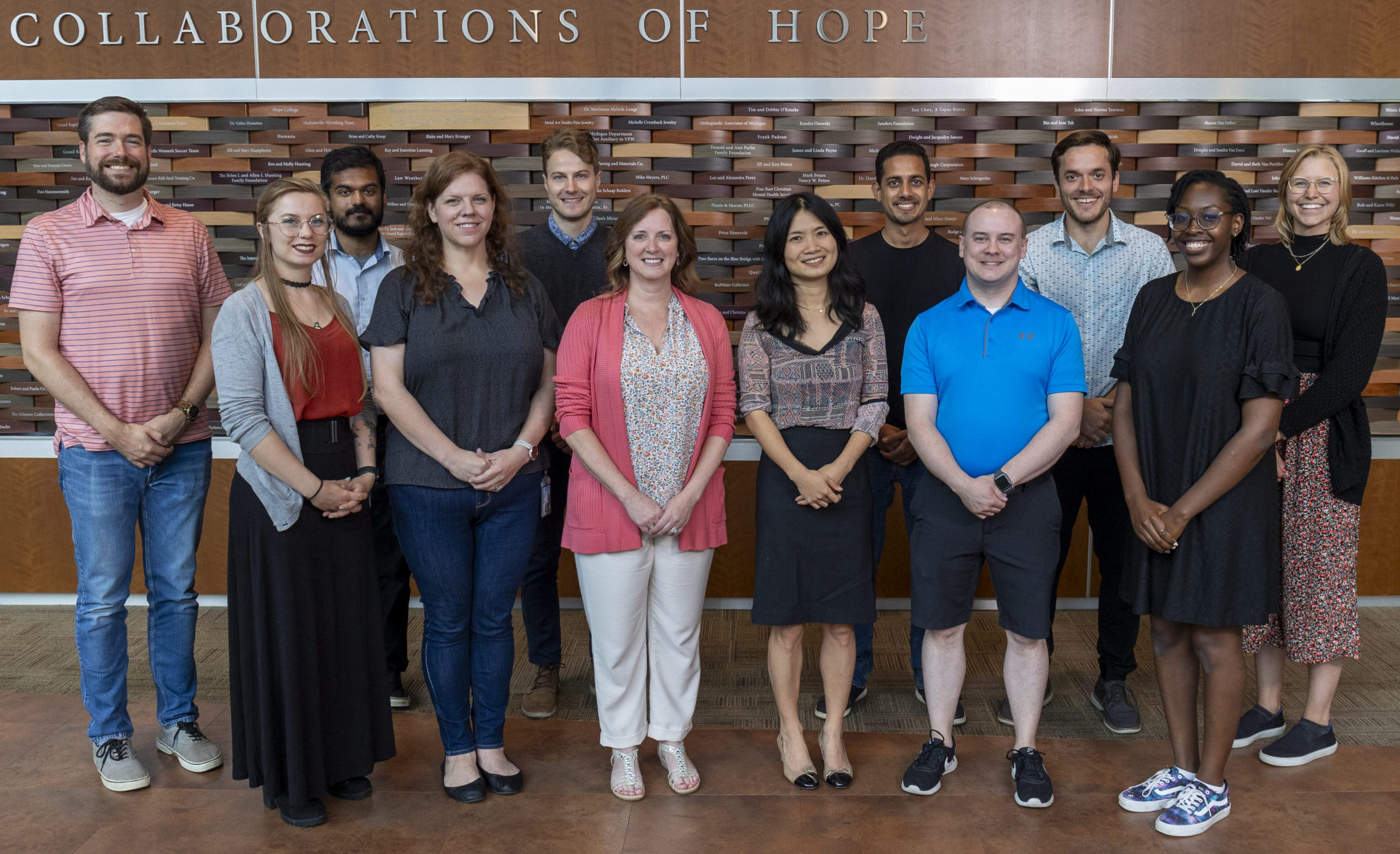

Paige Matusiak
Ph.D. Student, VAI Graduate School
Research Focus: Investigating transposable element activity in ovarian cancer subtypes

Jacob Morrison, Ph.D.
Bioinformatics Research Scientist, Department of Epigenetics

Amy Nuffesse
Senior Administrative Assistant II, Department of Epigenetics


Ayush Semwal, M.S.
Bioinformatics Analyst III, Department of Epigenetics

Natasha Zandstra
Ph.D. Student, VAI Graduate School
Research Focus: Identifying non-genetic determinants of stem-like phenotypes in high grade serous ovarian cancer